


Tarpon fishing should be strong this month as schools of fish increase in size and numbers. They will head off shore to spawn close to new and full moons. Set up in travel lanes along the beach at first light in the morning and cast live crabs, baitfish or DOA Baitbusters to them. Give other anglers several hundred yards of space. Since fish may be moving both north and south, setting up too close to another angler may negatively affect their fishing Use tackle heavy enough to land them as quickly as possible.
I usually drift a couple of live baits (crabs) under a float while we wait for tarpon schools to pass by. Blind casting with DOA Baitbusters, if you’re in the right spot, can also be productive when fish are moving past you but not showing well on the surface.
You should find snook in the surf, in passes and around docks and bridges in the ICW near passes. You can walk the beach and sight fish them in the surf with fly or spinning tackle. Small baitfish fly patterns or CAL jigs with shad tails and jerk worms should all work well.
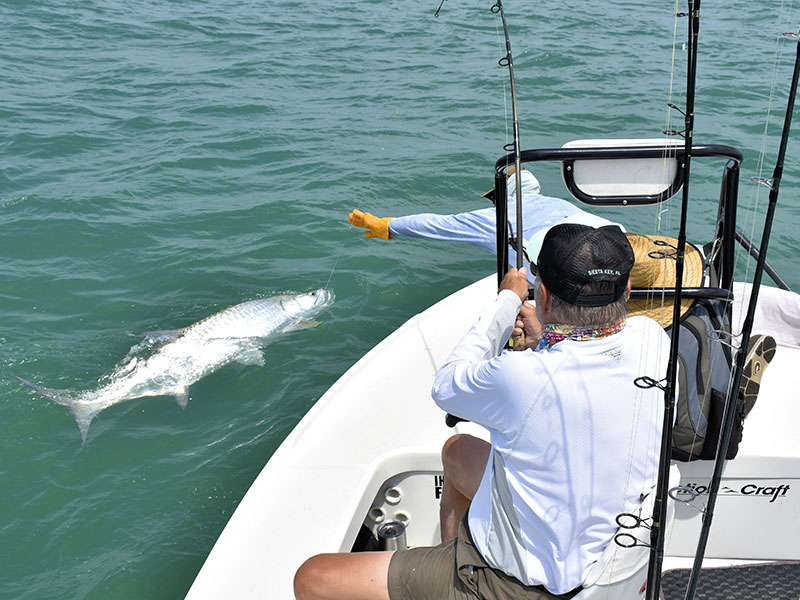
Dennis Ondercin, from OH, fighting a tarpon to the boat while fishing with Capt. Rick Grassett in previous June.
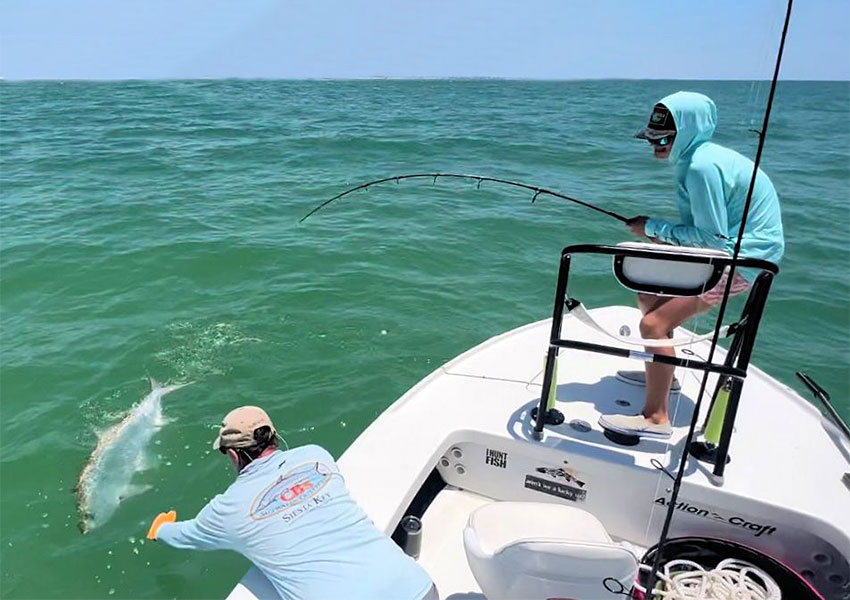
Mason Ondercin, from Sarasota, fighting a tarpon to the boat while fishing with Capt. Rick Grassett in previous June.
The same lures and flies that work in the surf will also work well at night. Snook will congregate in passes around the new and full moons to spawn. They will usually be in deep channels in these areas. Bouncing a DOA TerrorEyz or Baitbuster in bridge channels or passes can be an effective technique in these areas.
Fishing for reds should also be good in June. Look for them over shallow grass along mangrove shorelines or around oyster bars when the tide is high. Live bait anglers should score with pilchards. Top water plugs may also work well, especially early in the day. I like to cover water with CAL jigs and shad tails or jerk worms to find them. Fly anglers should score with baitfish fly patterns like my Grassett Flats Minnow.
You may find trout, Spanish mackerel, bluefish or pompano in passes or on deep grass flats this month. I like to drift deep grass flats and cast ahead of my drift with CAL jigs and shad tails or jerk worms or DOA Deadly Combos. Live shrimp under a popping cork is also a good option. Fly anglers should score by drifting and casting ahead of the drift with Ultra Hair Clouser flies tied on long shank hooks on an intermediate sink tip fly line. You’ll need to add a few inches of heavy (40 or 50-pound) fluorocarbon when toothy fish are in the mix.
You may also find Spanish mackerel, false albacore, cobia and tripletail in the coastal gulf this month… Keep your eyes open for bird activity or “breaking” fish to find albies and mackerel. Cobia and tripletail may be found around crab trap floats; however I’ve seen cobia swimming with tarpon schools before. Full regulations and details for all species can be viewed at www.myfwc.com.
Our natural resources are under constant pressure from red tides fueled by industrial, agricultural and residential runoff, toxic spills and discharges, freezes, increasing fishing pressure and habitat loss and degradation, please limit your kill, don’t kill your limit!

Rick is the owner of Snook Fin-Addict Guide Service, Inc. He's a full time fishing guide and outdoor writer based in Sarasota, FL. He’s been guiding since 1990 and is an Orvis-Endorsed fly fishing guide here at CB’s Saltwater Outfitters, the 2011 Orvis Outfitter of the Year.
Tarpon fishing should be strong this month as schools of fish increase in size and numbers. They will head off shore to spawn close to new and full moons. Set up in travel lanes along the beach at first light in the morning and cast live crabs, baitfish or DOA Baitbusters to them. Give other anglers several hundred yards of space. Since fish may be moving both north and south, setting up too close to another angler may negatively affect their fishing Use tackle heavy enough to land them as quickly as possible.
I usually drift a couple of live baits (crabs) under a float while we wait for tarpon schools to pass by. Blind casting with DOA Baitbusters, if you’re in the right spot, can also be productive when fish are moving past you but not showing well on the surface.
Dennis Ondercin, from OH, fighting a tarpon to the boat while fishing with Capt. Rick Grassett in previous June.
You should find snook in the surf, in passes and around docks and bridges in the ICW near passes. You can walk the beach and sight fish them in the surf with fly or spinning tackle. Small baitfish fly patterns or CAL jigs with shad tails and jerk worms should all work well.
The same lures and flies that work in the surf will also work well at night. Snook will congregate in passes around the new and full moons to spawn. They will usually be in deep channels in these areas. Bouncing a DOA TerrorEyz or Baitbuster in bridge channels or passes can be an effective technique in these areas.
Fishing for reds should also be good in June. Look for them over shallow grass along mangrove shorelines or around oyster bars when the tide is high. Live bait anglers should score with pilchards. Top water plugs may also work well, especially early in the day. I like to cover water with CAL jigs and shad tails or jerk worms to find them. Fly anglers should score with baitfish fly patterns like my Grassett Flats Minnow.
Mason Ondercin, from Sarasota, fighting a tarpon to the boat while fishing with Capt. Rick Grassett in previous June.
You may find trout, Spanish mackerel, bluefish or pompano in passes or on deep grass flats this month. I like to drift deep grass flats and cast ahead of my drift with CAL jigs and shad tails or jerk worms or DOA Deadly Combos. Live shrimp under a popping cork is also a good option. Fly anglers should score by drifting and casting ahead of the drift with Ultra Hair Clouser flies tied on long shank hooks on an intermediate sink tip fly line. You’ll need to add a few inches of heavy (40 or 50-pound) fluorocarbon when toothy fish are in the mix.
You may also find Spanish mackerel, false albacore, cobia and tripletail in the coastal gulf this month… Keep your eyes open for bird activity or “breaking” fish to find albies and mackerel. Cobia and tripletail may be found around crab trap floats; however I’ve seen cobia swimming with tarpon schools before. Full regulations and details for all species can be viewed at www.myfwc.com/ .
Our natural resources are under constant pressure from red tides fueled by industrial, agricultural and residential runoff, toxic spills and discharges, freezes, increasing fishing pressure and habitat loss and degradation, please limit your kill, don’t kill your limit!
Rick is the owner of Snook Fin-Addict Guide Service, Inc. He's a full time fishing guide and outdoor writer based in Sarasota, FL. He’s been guiding since 1990 and is an Orvis-Endorsed fly fishing guide here at CB’s Saltwater Outfitters, the 2011 Orvis Outfitter of the Year.
