


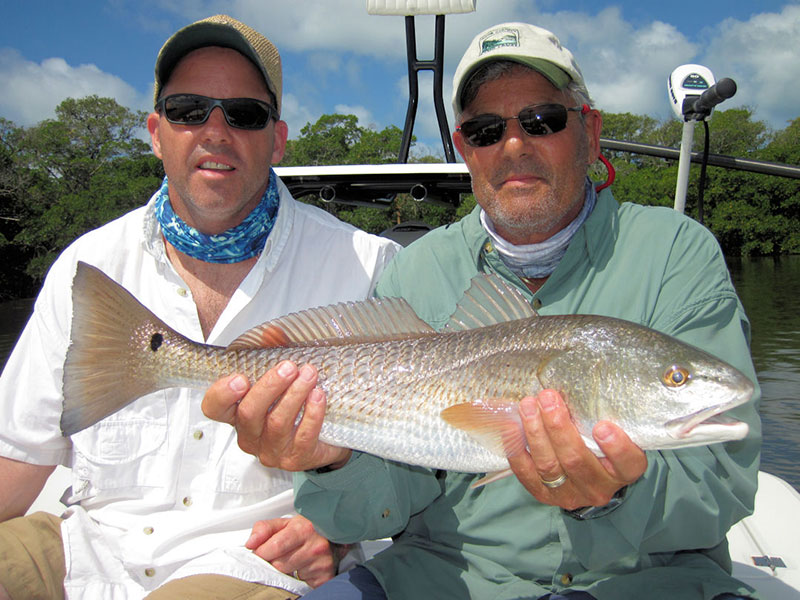
Bill and Scott Moore, from IL, with a Sarasota Bay Red caught and released while fishing with Capt. Grassett.
Tarpon fishing will take off during May as migratory fish arrive along our beaches. Resident tarpon are usually the first to show up as they make their way out of rivers and creeks.
As migratory tarpon start to arrive this month, we should have schools of tarpon moving both north and south along our beaches. Once you’ve seen the first school of fish, you can concentrate your efforts in that “lane” since other schools should be following the same route. Cast a DOA Baitbuster, a live crab or a pinfish to them. When they aren’t showing well on the surface, a live bait under a float in their travel lane may score.
Fly anglers should also get some shots with a variety of baitfish or crab fly patterns fished on floating or intermediate sink tip fly lines Be quiet and use your electric trolling motor sparingly. Give other anglers at least several hundred yards of space and keep in mind that fish can be moving either north or south so setting up too close to another angler may affect their flow of fish.
Snook will be spawning this month so use tackle heavy enough to catch and release them in a timely manner and handle them gently. Larger snook will mostly be females and should always be supported horizontally rather than hung vertically by the jaw. You’ll find them in passes and in the surf. They will also stage around docks and bridges close to passes. Casting CAL jigs with shad tails and jerk worms or DOA shrimp around docks and bridges close to passes should be effective. Small white flies, like my Grassett Snook Minnow, work well at night. One of the most fun ways to target snook is to walk the beach and cast CAL jigs, DOA Shrimp or flies to them in the surf.
Anglers fishing with me, out of CB’s Saltwater Outfitters on Siesta Key, had good action in Sarasota Bay with me recently.
Bill Morrison, from Anna Maria, and Don Morrison, from MA, fished a trip with me and had great action with trout and Spanish mackerel on flies and CAL jigs with shad tails. Dave Reinhart, from MA, fished skinny water with me on a blustery day later in the week.
Fish were turned on ahead of an approaching front. He caught and released a slam, including a 28” snook, 28” redfish, trout and a couple of pompano that were sight fished on top of a bar in 18” of water, all on CAL jigs with a grub tail! Not big numbers of fish but a great day for quality fish and variety.
Fishing deep grass flats of Sarasota Bay is a good choice for action with a variety of species including trout, pompano, blues and Spanish mackerel. Check the coastal gulf for Spanish mackerel, false albacore and tripletail when conditions are good.
Higher tides and more plentiful baitfish this month will mean that reds and big trout will spend more time feeding on shallow flats. Look for them along mangrove shorelines and around oyster bars when the tide is high and in potholes or along sandbars when the tide is low. When fishing shallow water for reds, be as quiet as possible. I prefer to use a push pole vs an electric trolling motor in shallow water. Spin fishing anglers should score with live pilchards or CAL jigs with paddle tails. Fly anglers will need floating lines, long leaders and baitfish fly patterns. Reds are one of the most challenging species to catch on a fly.
You may also find trout, pompano, bluefish and Spanish mackerel on deep grass flats. I prefer to cast CAL jigs with spinning tackle or flies on sink tip fly lines when fishing deep grass flats. A DOA Deadly Combo also works very well. Drifting and casting ahead of the drift is usually the most productive method. Look for flats that have a good mix of grass and sand and good tidal flow.
You may also find Spanish and king mackerel, false albacore (little tunny), cobia and tripletail in the coastal gulf. Keep your eyes open for surface activity such as diving birds, breaking fish or baitfish being forced out of the water which could indicate the presence of mackerel, blues or little tunny. Medium spinning tackle and 8 or 9-weight fly tackle should be heavy enough, although your tarpon spinning and fly tackle is not too heavy for Cobia. Look for Cobia either swimming on the surface or around navigational markers or buoys. I have also found Cobia swimming with schools of tarpon before.
Tripletail may be found around crab trap floats or buoys, where they can be targeted with a DOA shrimp or CAL jig on spinning tackle. When fly fishing for tripletail, a floating line on an 8 or 9-weight fly rod with a shrimp or baitfish fly pattern, like my Grassett Flats Minnow, should get the job done. Full regulations and details for all species can be viewed at www.myfwc.com.
There are plenty of options plenty of fishing options on both shallow and deep grass flats or in the coastal gulf during May.
Our natural resources are under constant pressure from red tides fueled by industrial, agricultural and residential runoff, toxic spills and discharges, freezes, increasing fishing pressure and habitat loss and degradation, please limit your kill, don’t kill your limit!

Rick is the owner of Snook Fin-Addict Guide Service, Inc. He's a full time fishing guide and outdoor writer based in Sarasota, FL. He’s been guiding since 1990 and is an Orvis-Endorsed fly fishing guide here at CB’s Saltwater Outfitters, the 2011 Orvis Outfitter of the Year.
Tarpon fishing will take off during May as migratory fish arrive along our beaches. Resident tarpon are usually the first to show up as they make their way out of rivers and creeks.
As migratory tarpon start to arrive this month, we should have schools of tarpon moving both north and south along our beaches. Once you’ve seen the first school of fish, you can concentrate your efforts in that “lane” since other schools should be following the same route. Cast a DOA Baitbuster, a live crab or a pinfish to them. When they aren’t showing well on the surface, a live bait under a float in their travel lane may score.
Fly anglers should also get some shots with a variety of baitfish or crab fly patterns fished on floating or intermediate sink tip fly lines Be quiet and use your electric trolling motor sparingly. Give other anglers at least several hundred yards of space and keep in mind that fish can be moving either north or south so setting up too close to another angler may affect their flow of fish.
Snook will be spawning this month so use tackle heavy enough to catch and release them in a timely manner and handle them gently. Larger snook will mostly be females and should always be supported horizontally rather than hung vertically by the jaw. You’ll find them in passes and in the surf. They will also stage around docks and bridges close to passes. Casting CAL jigs with shad tails and jerk worms or DOA shrimp around docks and bridges close to passes should be effective. Small white flies, like my Grassett Snook Minnow, work well at night. One of the most fun ways to target snook is to walk the beach and cast CAL jigs, DOA Shrimp or flies to them in the surf.
Anglers fishing with me, out of CB’s Saltwater Outfitters on Siesta Key, had good action in Sarasota Bay with me recently.
Bill Morrison, from Anna Maria, and Don Morrison, from MA, fished a trip with me and had great action with trout and Spanish mackerel on flies and CAL jigs with shad tails. Dave Reinhart, from MA, fished skinny water with me on a blustery day later in the week.
Fish were turned on ahead of an approaching front. He caught and released a slam, including a 28” snook, 28” redfish, trout and a couple of pompano that were sight fished on top of a bar in 18” of water, all on CAL jigs with a grub tail! Not big numbers of fish but a great day for quality fish and variety.
Fishing deep grass flats of Sarasota Bay is a good choice for action with a variety of species including trout, pompano, blues and Spanish mackerel. Check the coastal gulf for Spanish mackerel, false albacore and tripletail when conditions are good.
Bill and Scott Moore, both from IL, with a Sarasota Bay Red caught and released while fishing with Capt. Rick Grassett in a previous May.
Higher tides and more plentiful baitfish this month will mean that reds and big trout will spend more time feeding on shallow flats. Look for them along mangrove shorelines and around oyster bars when the tide is high and in potholes or along sandbars when the tide is low. When fishing shallow water for reds, be as quiet as possible. I prefer to use a push pole vs an electric trolling motor in shallow water. Spin fishing anglers should score with live pilchards or CAL jigs with paddle tails. Fly anglers will need floating lines, long leaders and baitfish fly patterns. Reds are one of the most challenging species to catch on a fly.
You may also find trout, pompano, bluefish and Spanish mackerel on deep grass flats. I prefer to cast CAL jigs with spinning tackle or flies on sink tip fly lines when fishing deep grass flats. A DOA Deadly Combo also works very well. Drifting and casting ahead of the drift is usually the most productive method. Look for flats that have a good mix of grass and sand and good tidal flow.
You may also find Spanish and king mackerel, false albacore (little tunny), cobia and tripletail in the coastal gulf. Keep your eyes open for surface activity such as diving birds, breaking fish or baitfish being forced out of the water which could indicate the presence of mackerel, blues or little tunny. Medium spinning tackle and 8 or 9-weight fly tackle should be heavy enough, although your tarpon spinning and fly tackle is not too heavy for Cobia. Look for Cobia either swimming on the surface or around navigational markers or buoys. I have also found Cobia swimming with schools of tarpon before.
Tripletail may be found around crab trap floats or buoys, where they can be targeted with a DOA shrimp or CAL jig on spinning tackle. When fly fishing for tripletail, a floating line on an 8 or 9-weight fly rod with a shrimp or baitfish fly pattern, like my Grassett Flats Minnow, should get the job done. Full regulations and details for all species can be viewed at www.myfwc.com.
There are plenty of options plenty of fishing options on both shallow and deep grass flats or in the coastal gulf during May.
Our natural resources are under constant pressure from red tides fueled by industrial, agricultural and residential runoff, toxic spills and discharges, freezes, increasing fishing pressure and habitat loss and degradation, please limit your kill, don’t kill your limit!
Rick is the owner of Snook Fin-Addict Guide Service, Inc. He's a full time fishing guide and outdoor writer based in Sarasota, FL. He’s been guiding since 1990 and is an Orvis-Endorsed fly fishing guide here at CB’s Saltwater Outfitters, the 2011 Orvis Outfitter of the Year.
