


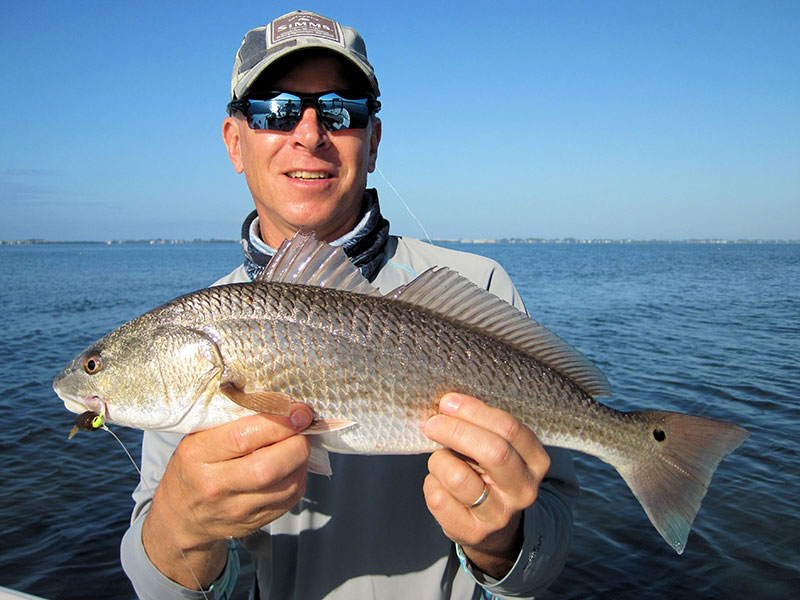
Marshall Dinerman with a trout, caught and released on CAL jigs with plastic tails while fishing Sarasota Bay in a previous March with Capt. Rick Grassett.
There should be good action with reds, trout and snook in skinny water in March as baitfish become more plentiful. Look for Spanish mackerel, cobia, tripletail and false albacore (little tunny) in the coastal gulf. Night snook fishing in the ICW should also be a good option this month.
This should be a good month for snook fishing at night around lighted docks and bridge fenders in the ICW. Live shrimp, DOA Shrimp, CAL jigs with shad tails and small white flies, like my Grassett Snook Minnow, usually work well at night since glass minnows and shrimp are the predominate bait.
Focus on shadow lines where light meets dark and fish strong tides for the best action. Although snook may also be found in rivers, creeks or canals in March, they will also start to move onto shallow flats, particularly on sunny afternoons when it’s warm like larger profile lures like CAL jigs with jerk worms, DOA Baitbusters and the DOA PT soft plastic top water lure or wide profile flies like Clousers, Deceivers and EP flies, for snook on the flats. Live bait anglers should do well on shallow flats with pilchards for reds, snook and trout.
Reds should be more active as the water warms and baitfish become more plentiful. Higher tides, as we head into spring, will allow them to spend more time feeding in shallow water. Look for them over shallow grass, along mangrove shorelines and around oyster bars when the tide is high. You should find them in potholes and along sand bars when the tide is low. I like the shallow flats of north Sarasota Bay for reds this month. I like 1/16-ounce CAL jigs with shad tails and jerk worms to locate reds. Fly anglers should score with my Grassett Flats Minnow fly, fished on a 10’-12’ leader.
You might also find reds around docks when the tide is low. Look for deep water under docks with a good tidal flow for the best action. A 1/8-ounce CAL jig with a shad tail or grub or a weighted fly fished on a clear intermediate sink tip fly line with a 6’ leader with should work well for dock fishing.
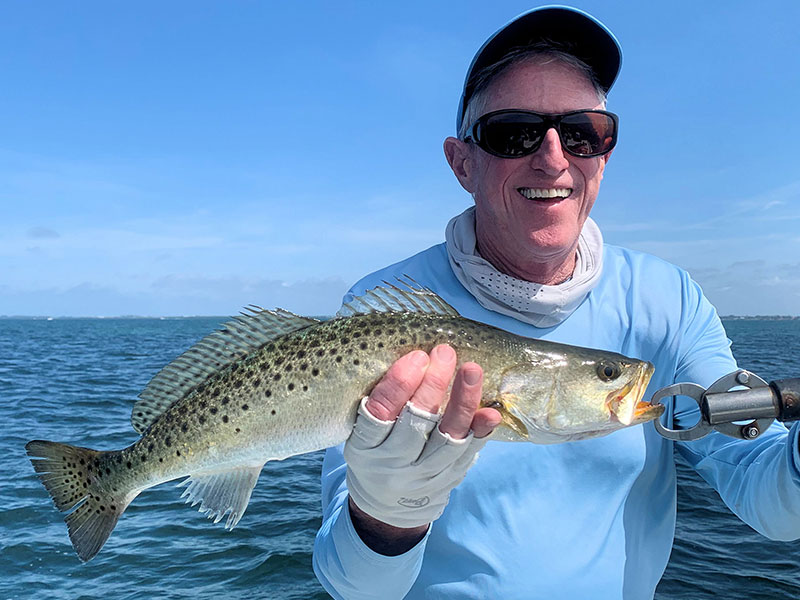
Jim Hazlett, from Sarasota, with a snook he caught and released on CAL jigs with plastic tails while fishing Sarasota Bay in a previous March.
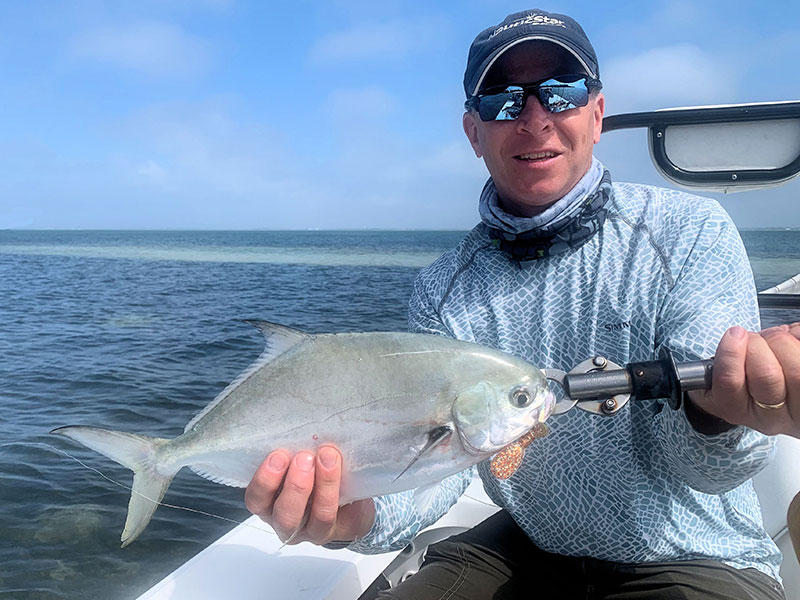
Dave Reinhart, from MA, with a pompano he caught and released on CAL jigs with plastic tails while fishing Sarasota Bay in a previous March with Capt. Grassett.
You may find big trout in skinny water in many of the same places that you find reds. Blind cast seams where grass meets sand or focus on light colored bottom, in potholes on top of sand bars, where you may be able to sight fish them. In my opinion it’s important to protect larger trout, which are usually female breeders, that are important to the health of our fishery. Full regulations and details for all species can be viewed at www.myfwc.com.
You should also find trout plentiful on deep grass flats along with Spanish mackerel, blues, flounder or pompano. I like to make a series of drifts, casting ahead of the drift with CAL jigs with shad tails, DOA Deadly Combos or an Ultra Hair Clouser fly tied on a long shank hook and fished on a clear intermediate sink tip fly line to locate fish. Live bait anglers should score with live shrimp or pilchards under a popping cork. Look for birds, bait showering out of the water or boils on the surface that will indicate fish feeding below. When mackerel and blues are around, you may need to add 6” of 40# to 60# fluorocarbon or wire to your leader.
Top water plugs and fly poppers also work well when blues and mackerel are around and may help locate them by attracting them from further away. Flounder may be found on sand or mud bottom areas on both shallow and deep grass flats or around docks. Pompano may skip on the surface when you drift or run past them, giving their location away. Fish deep grass flats with a mixture of grass and sand and a strong tidal flow for the best action.
You may also find Spanish mackerel, false albacore (little tunny), cobia or tripletail in the coastal gulf this month. Look for diving or hovering terns to find Spanish mackerel or false albacore feeding on the surface. ¼-ounce CAL jigs with shad tails or jerk worms or top water plugs should work well for spin anglers. Fly anglers should score with small white flies, like my Grassett Snook Minnow or Ultra Hair Clousers fished on an intermediate sink tip fly line.
Run crab trap lines at various depths to find tripletail or cobia around crab trap floats. Anglers should score on tripletail with live shrimp, DOA Shrimp or lightly weighted flies with weed guards. Cobia may also be swimming on the surface as they migrate from south to north following warmer water and baitfish. DOA Baitbusters, PT’s and large, wide profile flies, like Deceivers or EP flies would be good fly choices for cobia. In the absence of any fish on the surface, check out one of the many artificial reefs or natural hard bottom areas that may hold baitfish and predators. Drift over structure and cast DOA Baitbusters or weighted flies on fast sinking fly lines to get deeper in the water column to catch them.
Conditions are usually good during March and fishing should heat up. Flats and night snook fishing are usually good options this month. I like to check the coastal gulf when conditions are good, since you could find something really good happening there.
Our natural resources are under constant pressure from red tides fueled by industrial, agricultural and residential runoff, freezes, increasing fishing pressure and habitat loss and degradation, please limit your kill, don’t kill your limit!

Rick is the owner of Snook Fin-Addict Guide Service, Inc. He's a full time fishing guide and outdoor writer based in Sarasota, FL. He’s been guiding since 1990 and is an Orvis-Endorsed fly fishing guide here at CB’s Saltwater Outfitters, the 2011 Orvis Outfitter of the Year.
There should be good action with reds, trout and snook in skinny water in March as baitfish become more plentiful. Look for Spanish mackerel, cobia, tripletail and false albacore (little tunny) in the coastal gulf. Night snook fishing in the ICW should also be a good option this month.
This should be a good month for snook fishing at night around lighted docks and bridge fenders in the ICW. Live shrimp, DOA Shrimp, CAL jigs with shad tails and small white flies, like my Grassett Snook Minnow, usually work well at night since glass minnows and shrimp are the predominate bait.
Jim Hazlett, from Sarasota, with a snook he caught and released on CAL jigs with plastic tails while fishing Sarasota Bay in a previous March.
Focus on shadow lines where light meets dark and fish strong tides for the best action. Although snook may also be found in rivers, creeks or canals in March, they will also start to move onto shallow flats, particularly on sunny afternoons when it’s warm like larger profile lures like CAL jigs with jerk worms, DOA Baitbusters and the DOA PT soft plastic top water lure or wide profile flies like Clousers, Deceivers and EP flies, for snook on the flats. Live bait anglers should do well on shallow flats with pilchards for reds, snook and trout.
Reds should be more active as the water warms and baitfish become more plentiful. Higher tides, as we head into spring, will allow them to spend more time feeding in shallow water. Look for them over shallow grass, along mangrove shorelines and around oyster bars when the tide is high. You should find them in potholes and along sand bars when the tide is low. I like the shallow flats of north Sarasota Bay for reds this month. I like 1/16-ounce CAL jigs with shad tails and jerk worms to locate reds. Fly anglers should score with my Grassett Flats Minnow fly, fished on a 10’-12’ leader.
You might also find reds around docks when the tide is low. Look for deep water under docks with a good tidal flow for the best action. A 1/8-ounce CAL jig with a shad tail or grub or a weighted fly fished on a clear intermediate sink tip fly line with a 6’ leader with should work well for dock fishing.
Dave Reinhart, from MA, with a trout, caught and released on CAL jigs with plastic tails while fishing Sarasota Bay in a previous March with Capt. Rick Grassett.
You may find big trout in skinny water in many of the same places that you find reds. Blind cast seams where grass meets sand or focus on light colored bottom, in potholes on top of sand bars, where you may be able to sight fish them. In my opinion it’s important to protect larger trout, which are usually female breeders, that are important to the health of our fishery. Full regulations and details for all species can be viewed at www.myfwc.com.
You should also find trout plentiful on deep grass flats along with Spanish mackerel, blues, flounder or pompano. I like to make a series of drifts, casting ahead of the drift with CAL jigs with shad tails, DOA Deadly Combos or an Ultra Hair Clouser fly tied on a long shank hook and fished on a clear intermediate sink tip fly line to locate fish. Live bait anglers should score with live shrimp or pilchards under a popping cork. Look for birds, bait showering out of the water or boils on the surface that will indicate fish feeding below. When mackerel and blues are around, you may need to add 6” of 40# to 60# fluorocarbon or wire to your leader.
Top water plugs and fly poppers also work well when blues and mackerel are around and may help locate them by attracting them from further away. Flounder may be found on sand or mud bottom areas on both shallow and deep grass flats or around docks. Pompano may skip on the surface when you drift or run past them, giving their location away. Fish deep grass flats with a mixture of grass and sand and a strong tidal flow for the best action.
You may also find Spanish mackerel, false albacore (little tunny), cobia or tripletail in the coastal gulf this month. Look for diving or hovering terns to find Spanish mackerel or false albacore feeding on the surface. ¼-ounce CAL jigs with shad tails or jerk worms or top water plugs should work well for spin anglers. Fly anglers should score with small white flies, like my Grassett Snook Minnow or Ultra Hair Clousers fished on an intermediate sink tip fly line.
Run crab trap lines at various depths to find tripletail or cobia around crab trap floats. Anglers should score on tripletail with live shrimp, DOA Shrimp or lightly weighted flies with weed guards. Cobia may also be swimming on the surface as they migrate from south to north following warmer water and baitfish. DOA Baitbusters, PT’s and large, wide profile flies, like Deceivers or EP flies would be good fly choices for cobia. In the absence of any fish on the surface, check out one of the many artificial reefs or natural hard bottom areas that may hold baitfish and predators. Drift over structure and cast DOA Baitbusters or weighted flies on fast sinking fly lines to get deeper in the water column to catch them.
Dave Reinhart with a pompano he caught and released on CAL jigs with plastic tails while fishing Sarasota Bay in a previous March with Capt. Rick Grassett.
Conditions are usually good during March and fishing should heat up. Flats and night snook fishing are usually good options this month. I like to check the coastal gulf when conditions are good, since you could find something really good happening there.
Our natural resources are under constant pressure from red tides fueled by industrial, agricultural and residential runoff, freezes, increasing fishing pressure and habitat loss and degradation, please limit your kill, don’t kill your limit!
Rick is the owner of Snook Fin-Addict Guide Service, Inc. He's a full time fishing guide and outdoor writer based in Sarasota, FL. He’s been guiding since 1990 and is an Orvis-Endorsed fly fishing guide here at CB’s Saltwater Outfitters, the 2011 Orvis Outfitter of the Year.
